“In view of the considerable social importance of sporting activities and in particular football in the community, the aims of maintaining a balance between clubs by preserving a certain degree of equality and uncertainty as to results and of encouraging the recruitment and training of young players must be accepted as legitimate,” (Bosman, para. 106)
Professional football is governed by a multitude of regulations designed to maintain fairness and promote the development of young talent. Following the landmark Bosman ruling, two key policy mechanisms implemented to do this were the training compensation and solidarity payment systems. Both mechanisms play a crucial role in ensuring that clubs investing in the training of young players are duly compensated.
Training Compensation
The training compensation system was implemented by FIFA following the Bosman ruling as one of the initiatives to encourage the recruitment and training of youth players in the international transfer system. However, while the payment of transfer fees applies to all players under a contract, the payment of training compensation only applies to players under the age of 23 (Geey, 2020). UEFA is responsible for ensuring that the training compensation fee system is implemented and it was designed in response to the ECJ ruling in Bosman that recognised the training of youth players as a legitimate objective.
The regulations stipulate that a compensation is payable to a player’s training club(s) responsible for the training and development of the player between the ages of 12 and 21 years old (FIFA, 2024, Annexe 4). Training compensation is entitled to “every club with which the player has previously been registered (in accordance with the players’ career history as provided in the player passport) and that has contributed to his training starting from the season of his 12th birthday” (FIFA, 2024, Annexe 4, Art.3). However, no training compensation will be due if the former club terminate the player’s contract without cause or when a professional player regains amateur status after a transfer (FIFA, 2024, Annexe 4, Art.2)[1]
The amount becomes payable when then player signs his first professional contact and then each time the player transfers clubs until the end of the season of the year the player turns 23 years old (FIFA, 2024, Art.20). Payment of the compensation fee must be made within 30 days of the player’s registration with the new national association (FIFA, 2024, Annexe 4, Art.3). The compensation is only payable with respects to an international transfer and as such, a training club will not be entitled to receive a training compensation fee if the players transfer to a domestic club (a club within the same national association). This is because the RSTP governs the transfer of players internationally, moving between two different national associations (FIFA, 2024, Art.1). The training compensation fees is also payable irrespective of a transfer fee being involved in the players move and whether the player is in a contract with a club or at the end of his contract (Geey, 2020). The amount payable can differ from club to club and the cost are dependent on the categorisation of the club on a confederation level and with respect to the club’s categorisation by the National FA; both of which are published on the FIFA website (FIFA, 2024, Annexe 4). The training club(s) must also be a member of a national association under FIFA.[2]
In calculating sums due as training compensation for the first transfer after signing the first professional contract, FIFA sets a general rule that the new club considers the amount it would have cost them to train the player themselves, multiplied by the number of years of training and development the player would have had between the ages of 12 and 21 years old (FIFA, 2024, Annexe 4). Any subsequent transfer will follow a similar pattern by multiplying the number of years of training with the now former club, with the training cost of the new club. This calculation is used when players transfer internationally but FIFA includes a different calculation system for the EU. The same calculations are also applicable to player loan transfers in accordance with Article 10 RSTP (FIFA, 2024). In a situation where the training club(s) cannot be located, no longer involved in professional football, or is no longer in operation, then the amount due for training compensation is paid to the relevant national association.
The legitimacy of the training compensation mechanism implemented by the French League was also considered by the ECJ in the Bernard case in 2008. Assessing its legality in the political and policy stream, the ECJ stated that the principle on which it operates, whereby payment of a financial compensation is awarded a training club when he signs a professional contract with a different club is justified because it is proportional to its objective of incentivising the recruitment and development of youth players(Olympique Lyonnais SASP v Olivier Bernard and Newcastle UFC, 2008). The court did rule that the French training compensation scheme did go beyond what is considered proportionate to the objective it was pursuing. This was because the payment which Olympique Lyonnais were seeking from Newcastle for the transfer surpassed the actual amount calculated for training costs, and included what was considered to be unrelated damages for a breach of contract.
The ECJ noted in its ruling that in order for such a mechanism to be legal, it ‘must be actually capable of attaining that objective and be proportionate to it, taking due account of the costs borne by the clubs in training both future professional players and those who will never play professionally’ (Bernard, para. 45). This direction is intended to ensure a legitimate framework is implemented with equity for its stakeholders at the forefront and in turn, further reduce the deviances that are bred within governance frameworks when a sporting organisation insulates itself from state legislation. The payments are now automated via FIFA clearing house following the recent reform to the transfer system.
A special case for the EU/EEA
There are slightly different provisions with regards to calculating the compensation due for a player transferring from a club in one association to another within the territory of the EU/EEA. Firstly, a player can be deemed to have completed his training and development before the aforementioned stipulated final calendar year of the player’s 21st birthday. This would mean that if established, the training compensation due to the new club can be calculated using a final calendar year of training as one before the player’s 21st birthday.
Furthermore, based on the published categories on FIFA’s websites, when a player transfers from a lower category club to a higher category club, the training compensation due is calculated based on the average training cost of the two clubs (FIFA, 2024, Annexe 4). Alternatively, when a player transfers from a higher category club to a lower category club, then the fee payable is based on the training costs of the club in the lower category (FIFA, 2024, Annexe 4). However, this is no longer applicable to associations within the United Kingdom. As noted by FIFA (2021, p.318) in its commentary, “following the United Kingdom’s withdrawal from the EU and considering that it also no longer forms part of the EEA, as from 1 January 2021 article 6 of annexe 4 no longer applies to the registration or transfer of players that would ordinarily trigger payment of training compensation, whether to or from clubs affiliated to The FA, the Scottish Football Association, the Irish Football Association, or the Football Association of Wales.”
Solidarity Payments
Solidarity payments were another mechanism introduced with the International Transfer System following the Bosman ruling. When a player transfer to another club in a different association, a portion of 5% of the full transfer fee paid for the player, shall become payable by the new club to the player’s previous clubs that have been responsible for his training and education between the ages of 12 and 23 years old (FIFA, 2024, Art.21). The 5% fees is spread the players previous clubs using formula set out by FIFA in the Regulations (FIFA, 2024, Annexe 5, Art.1).
Albeit similar to the training compensation provision, there are some key differences between the two. One key difference is that solidarity payments are only payable when a player, who is already professional, makes an international transfer to another club. Furthermore, it is also only payable when a transfer fee is paid for a player between two clubs in different national associations, prior to the expiration of the player’s employment contract. However, like training compensation, solidarity payments are also payable on loans that involve loan transfer fees for a player, in accordance with Article 10 RSTP (FIFA, 2024). Another similarity to the training compensation is that the national association will be entitled to a portion of the solidarity payment where the training club(s) cannot be located, no longer involved in professional football, or is no longer in operation (FIFA, 2024, Annexe 5, Art.2 (3)). Solidarity payments are due within 30 days after the player is registered by the new club or 30 days after a payment when contingent fees are involved (FIFA, 2024, Annexe 5, Art.2).
In a study commissioned by the EU Commission (European Commission et al., 2013), it was found that there was an issue of competitive imbalance that was prevalent within the football transfer market and one of the main reasons for this was the solidarity payment mechanism (particularly the UEFA solidarity mechanism). The study argued that solidarity payments focused on the wealthiest and most successful clubs in the leagues, urging the governing bodies to look into reforming the mechanism for a better equitable distribution of funds down the pyramid, as this will facilitate youth development and go toward remedying the competitive imbalance prevalent in a number of leagues (European Commission et al., 2013). Similarly, FIFPro, in its complaint to the European Commission, noted that the intended redistribution effect of mechanisms such as the solidarity payment system is rather limited and does not adequately address the competitive and financial balance within the football pyramid. This is because the highest transfer spending is done between the biggest clubs and as such, the sums are being re-circulated among the big clubs as opposed to trickling down the football pyramid (De Marco, 2022, p.84). Therefore, it would seem that only a limited amount of clubs and countries benefit from this mechanism of the transfer system. FIFA Clearing House (FCH) was established to address these issues of financial imbalances and ensure transparency of these payments.
In September 2022, the FCH was granted a licence that allowed it to operate as a payment institution and once its regulations were approved by the FIFA Council, the FCH became operational in November 2022. The FCH serves as a separate entity from FIFA, serving as a system “to centralise, process and automate payments between clubs, initially relating to training rewards (training compensation and solidarity contribution)… [and] promote financial transparency and avoid fraudulent conduct in the football transfer system” (FIFA, 2022, p. 30). It acts as an intermediary in handling payments concerned with football transfers, to ensure that training compensation and solidarity payments are made. It allows FIFA to be able to generate an accurate player passport where a player’s training history can be traced, and in turn, facilitate the payment of training compensations and solidarity payments. It should be noted that the FCH is only used for paying training rewards (detailed in the section below) while the transfer fees and agreements are processed used the FIFA Transfer Matching System (TMS). The diagram below shows how this process flows between the necessary parties.
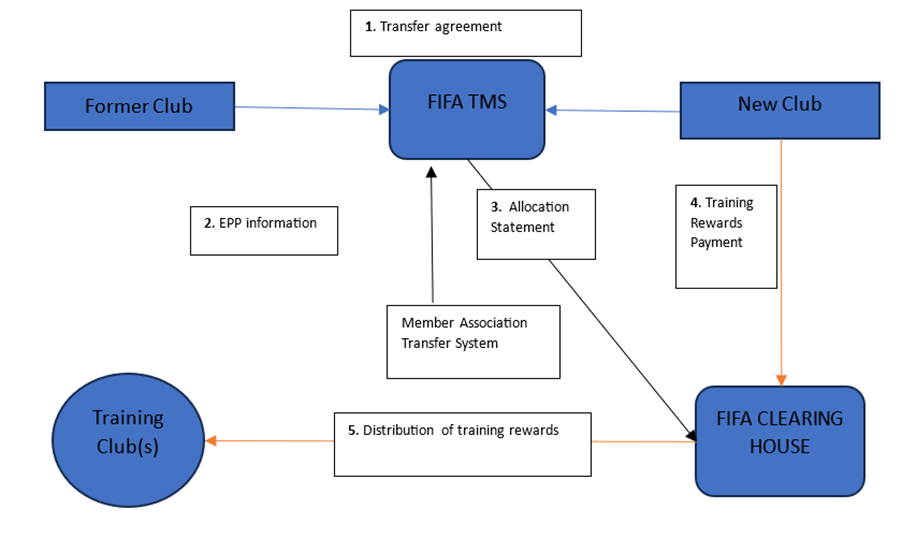
In conclusion, the training compensation and solidarity payments mechanisms play vital roles in maintaining the integrity and balance of football governance. While these systems aim to incentivize the development of young talent and ensure fair distribution of funds, ongoing reforms and innovations like the FIFA Clearing House are essential to address financial imbalances and enhance transparency. There are also questions on the system in practice and its effectiveness in achieving these aims. By continuously evaluating and refining these mechanisms, football governing bodies can better support youth development and promote competitive equity across EU and Non-EU leagues.
References
- De Marco KC, N. (Ed.). (2022). Football and the Law. Bloomsbury Publishing Plc
- Geey, D. (2020). Done deal: An insider’s guide to football contracts, multi-million pound transfers and Premier League big business. Bloomsbury Sport.
- European Commission, Dalziel, M., Downward, P., Parrish, R., Pearson, G., & Semens, A. (2013). Study on the Assessment of UEFA’s Home-Grown Player Rule. European Commission.
- FIFA. (2021). Commentary on the FIFA Regulations on the Status and Transfer of Players. FIFA. https://digitalhub.fifa.com/m/346c4da8d810fbea/original/Commentary-on-the-FIFA-Regulations-on-the-Status-and-Transfer-of-Players-Edition-2021.pdf
- FIFA. (2022). The Reform of The Transfer System 2017-2022. FIFA. https://digitalhub.fifa.com/m/3763fd3a3b4cb319/original/Report-The-reform-of-the-Transfer-System.pdf
- FIFA. (2024). Regulations on the Status and Transfer of Players. https://digitalhub.fifa.com/m/6a0797ec77cbc02c/original/Regulations-on-the-Status-and-Transfer-of-Players-February-2024-edition.pdf
[1] There is also no training compensation payable if the player transfers to a Category 4 club (FIFA, 2024, Annexe 4, Art.2).
[2] This was considered further by CAS in the below case CAS 2008/A/1751, Brazilian Football Federation v. Sport Lisboa e Benfica-Futebol S.A.D., award of 5 August 2009
 REREGULATE: THE CHANGING LANDSCAPE OF PROFESSIONAL FOOTBALL
Leave a comment